
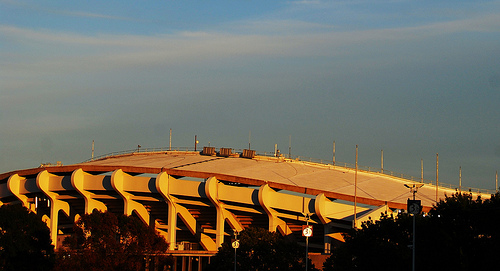
image uploaded by sidewalk flying on Flickr
By Michael Hoffman
Walking through the National Building Museum’s latest exhibit, Unbuilt Washington, it’s hard not to consider the debate about whether the city should allow the Washington Redskins to build their new headquarters and training facility in Capitol Hill East next to RFK stadium.
Sketches hang on the walls of canals running through what is now the Mall and exquisite bridges replacing the dull ones that cross the rivers today. One sketch even shows elaborate parks lining the Anacostia next to a proposed stadium. Of course, RFK got built, but the parks seen in the drawings have been replaced by abandoned buildings on a lot known as Reservation 13.
I’m afraid if the National Building Museum put together another Unbuilt Washington exhibit 20 years from now the museum curators would use sketches of the waterfront restaurants, condos, and retail stores seen in the master Hill East redevelopment plan voted on by the City Council in 2002.
Until reports appeared of a secret trip to Tampa Bay taken by Mayor Vincent C. Gray and D.C. Councilman Jack Evans to see the Buccaneers training facility, no one was talking about redeveloping Capitol Hill East. An entire decade passed without any real movement to act on the master plan to replace the eyesore that sits on the Anacostia River today.
And here’s why:
Lost in the sweeping statements about how Hill East is one of the most desirable plots of land left in D.C. to redevelop is the discussion about what stands there now: the D.C. Jail, a methadone clinic, a homeless shelter and a sexually transmitted disease clinic. Where will these services go if they are replaced by fancy bistros and high end condominiums? Which city councilman is going to raise his hand and offer up his ward for the transfer of a homeless shelter or a methadone clinic? And how many restaurant owners want to build an outdoor patio next the DC Jail, which is too expensive to move?
This is exactly why as a Hill East resident I’m not completely dismissing the notion of welcoming the Redskins to the neighborhood. Having the Redskins return could actually spur redevelopment in the neighborhood, not ruin it. In a perfect world, I would agree with D.C. Councilman Tommy Wells and say I would much rather see the area reap the benefits of waterfront development.
But this is Washington D.C. where Marion Barry is still an elected official and a city councilman is going to jail for setting up a fake youth baseball charity to steal money. Sorry if I don’t have a ton of faith in the city council navigating the political landmines of moving a homeless shelter or methadone clinic in a timely manner.
This is why welcoming the Redskins makes sense. Nothing else brings this town together quite like the Redskins despite their recent record. Giving a councilman the opportunity to tell his constituents he was responsible for bringing the Redskins back to DC because he agreed to build a homeless shelter in his ward might be Hill East’s only hope.
According to preliminary proposals of where the Redskins facility would be built, there would still be room to build a portion of the waterfront development seen in the master plan, albeit a smaller scale. At this point I’d rather see a smaller version of the plan built rather than wait another 10 years and see Reservation 13 still stand.
If welcoming the Redskins back to Hill East and sacrificing a few restaurants means removing those abandoned buildings and starting the redevelopment project, then I’d say Hail to the Redskins.
This headline makes me feel like the Jeremy Lin ESPN headline made me feel…
Can’t blame the author for that. He isn’t insisting on the racist name for the team…
This headline makes me feel like the Jeremy Lin ESPN headline made me feel…
“Nothing else brings this town together quite like the Redskins despite their recent record.”
Let me translate: You are only a true Washingtonian if you root for the Redskins. Fans of other teams or people who don’t care about football: get on the bandwagon or keep quiet. We’d still like your tax money though…
“Nothing else brings this town together quite like the Redskins despite their recent record.”
Let me translate: You are only a true Washingtonian if you root for the Redskins. Fans of other teams or people who don’t care about football: get on the bandwagon or keep quiet. We’d still like your tax money though…
Well said Mr. Hoffman. Many of your neighbors agree completely. Mr. Krepp, your “translation” is extremely disappointing and cynically misses the author’s point completely; doing so in a mean-spirited manner. Laden throughout your writings on this topic are constant anti-Redskins/anti-Redskins fans sentiments. Your arguments against the training facility move would carry much more weight were they not sprinkled with such ignorance for sports culture and general “hating.”
Erik
14th St NE
It’s Tim, and that’s my point. I have nothing against sports culture, even if I don’t share in it. While I do have serious issues with the Redskins (name, owner, and history), but I also sincerely admire their fan base. They’ve put up with some really rotten stuff, and I really do think well of their loyalty to thick and thin. They’ll be better some day (all teams are), and I wish them well when they do. But mostly, I just don’t care. I’m not a hater of the Redskins. I’m a not-carer-about of them.
But, here’s what I do care about. Football is a bad fit for an urban environment. There is no such thing as a good urban football stadium. And we’re not even talking about a stadium, we’re talking about a training facility. And as I’ve already said, this is a bad plan even for that. It’ll separate me from the mixed use development I want two blocks from my house. At best, it will leave room for a much diminished use 6 blocks from my house.
This NOT going to unite the community. It’s going to divide the community along fault lines that are already becoming clear. It’s going to be bitter, and going to get worse. The idea that Redskins are a unifying element is rather dismissive of those of us who just don’t care about them. We’re residents of DC too.
I know my tongue can be pointed, but I do want to remember that folks like Erik and Michael are my neighbors no matter what happens, even if I strongly disagree with your ideas on this topic. This is going to get ugly, but I want to do my part to stay focused on the issues and not get personal.
Wait, there’s no such thing as a good urban football stadium? What about Soldier Field? Qwest Field?
Of course not everyone in the city cares about the Redskins. Not everyone would care about the restaurants, etc. that are planned either. I think the points about uniting the city tie into the fact that those who do support the Redskins come from all walks of life and aren’t limited to one socioeconomic group, race, ward, etc.
Additionally, a point that I don’t see brought up here (though it may have been brought up on previous articles on THIH; I’m not sure how many have been written on this issue) is that a team’s payroll taxes are typically paid (at least partially) to the jurisdiction in which its training facilities are located, so this could be a revenue source for the city.
Soldier Field is nice. Quite nice in my opinion. It’s right along smack in the middle of the Brunham Plan, which is a great civic resource for the city of Chicago. But it’s hardly a mixed used development. I’d say it’s much more analogous to the Mall, a space held in common for the city (or in the case of the Mall, the nation) at large. It’s not exactly what I want across the street from me.
And Qwest Field just serves to kill off any hope of development of from Safeco field to the south.
Placing something in the city doesn’t make it a wise urban usage. A 100,000 person stadium sits empty, at best, 300 plus days of the year.
And no, taxes in DC are paid to your residence. So unless the players chose to move here, no.
Ah, so by “no such thing as a good urban football stadium,” you mean, “no such thing as an urban football stadium that’s also a mixed use development.” Two completely different things. You don’t think there should be urban stadiums, obviously a matter of opinion, not fact.
I meant to state the team’s taxes, not payroll taxes so yes, it would be a source of tax revenue. If a team’s practice facilities and stadium are located in two different jurisdictions, the jurisdictions often share tax revenue. My apologies that I accidentally added the word “payroll.” I was typing quickly. So, yes, it would be a potential source of revenue.
For someone who claims to want something that’s going to bring the two sides of the river together and who claims to want what’s best for the city as a whole, you seem to be awfully focused on what’s best for you. If it’s about what’s best for you and other Hill East residents, I agree that restaurants, etc. would be better. If it’s about what’s best for the city, I disagree. Which one are you arguing? If you’re not just arguing what’s best for Hill East residents, why mention that it’s not what you want across the street from you? I think you have a good argument and it’s great that Hill East residents have a voice, but I don’t understand why you seem to be switching your argument between what’s best for Hill East residents and what’s best for the city as a whole.
Anyway, neither of us are going to change our minds and I’m sure we both think the other is being condescending, so I’m done with this topic.
Michael, Sorry — but I have to take issue with your basic assertion that nothing has happened on the plan and “no one was talking about redeveloping Capitol Hill East.” This is just flat out incorrect. Four (4) developers submitted plans in 2008 (and ANC 6B endorsed one of those plan) — and two of those developers re-submitted plans when the District changed its mind and modified the proposal. The interest is there — the District just hasn’t followed through.
Quick time line:
1) DC General closed
2) Plan adopted 2002;
3) Plan put on hold while District tries to decided whether to re-create DC General in the form of the National Capital Medical Center on the site —
issue resolved in 2006 with passage of Community Access to Health Care Amendment Act of 2006.
4) Federal government finally transfers ownership of site to DC (without which DC could not ask for development plans) with passage of P.L. 109-396
Issue still completely not resolved until 2010 when — as required as a condition of the land transfer, DC finds a site for Congressional mail sorting facility.
5) Zoning on site approved in 2008 (after 4 years work to create a form-based zoning code for the site).
6) May 2008 Deputy Mayor for Planning and Economic Development (DMPED) issues a Request for Expressions of Interest
7) Four (4) developers respond to the RFEI
8) Jan 2009 — ANC 6B endorses one of the plans
9) April 2010 –citing market conditions [remember, that thing they call the Great Recession?] DMPED pulls back and issues a modification to the RFEI to develop just the area around the Metro site as a first phase
10) Two (2) developers submit revised plans
So — the history here is one of a constant battle to overcome the barriers to the development of the site. Now — with the real estate market turning around and all of the background work done (ownership transfer, zoning), it makes no sense to walk away from the plan.
As for your other statement, “According to preliminary proposals of where the Redskins facility would be built, there would still be room to build a portion of the waterfront development seen in the master plan, albeit a smaller scale. ” — well this is completely incorrect as well. According to those plans, the most valuable parts of the site — including the street frontage on Independence Ave and the area around the Metro station, would be used for the training facility. What would be left would be trapped between the private training facility and the jail. Rather than creating a neighborhood, it would create an isolated wasteland strip.
So if you want to keep all of the undesirable uses on the site, then support the Redskins plan. The training facility will guarantee that nothing else gets developed on the site.
Ken Jarboe
Redskins are shopping around in Richmond too:
http://www.washingtonpost.com/blogs/football-insider/post/redskins-considering-richmond-as-training-camp-site/2012/03/07/gIQAbPfUxR_blog.html
Another item about Reservation 13… DC Water has 2 rather large Sewage Overflow Facilities there and currently building a large infrastructure project in progress, expected completion is 08/2013. This is right in the middle of proposed Redskin Training Facility and impossible to relocate out of the way.
I think this is probably a tempest in a teapot. Snyder is just shopping around, trying to get the best deal possible. The real danger is exactly what’s happening, using the dream of the Redskins to further delay the plans that already exist.
RDnDC — a slight modification to the DC Water statement. There is a DC Water facility at the edge of Res 13 — between Res 13 and south RFK parking lots — located on National Park Service land. If you look at Mike DeBonis’ piece in the Post (http://wapo.st/xcGf15), the facility would get in the way of placing the training facility on a combination of Res 13 and the south parking lots — it does not interfere with any development on Res 13 itself. The large new sewer overflow infrastructure is almost all underground and will not interfere with any development on the site.
RDnDC — a slight modification to the DC Water statement. There is a DC Water facility at the edge of Res 13 — between Res 13 and south RFK parking lots — located on National Park Service land. If you look at Mike DeBonis’ piece in the Post (http://wapo.st/xcGf15), the facility would get in the way of placing the training facility on a combination of Res 13 and the south parking lots — it does not interfere with any development on Res 13 itself. The large new sewer overflow infrastructure is almost all underground and will not interfere with any development on the site.
The point missed in this article is that the Reservation 13 land is not the site of RFK, its the site south of it. This proposed land give-away to Dan Snyder is to let them build a training facility now, not to “return the Redskins to DC.” The craziest part of this logic is that if we can just hand over this incredibly valuable DC-owned land, they will build a fenced-off facility right next to a metro that they would not use to get to their training facility, and then, if we’re so lucky, we will get to pay to build a fancy new stadium for the team but not until 2027 when they can get out of their FedEx lease. And if you look at the recent new NFL stadiums built for other teams (Dallas and New York), you’ll see that the pricetag will be enormous. THat is another debate for the City to have in 2027, but let’s not confuse the two issues as the same.
Giving the team these 30 acres right on a metro would waste valuable sources of development potential and City revenues.