
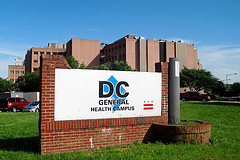
photo by M.V. Jantzen
I don’t remember my Dante well enough, but I believe community meetings are featured in the 4th ring of Hell, correct?
I bring this up, because last night, Councilmember Wells hosted a meeting to discuss with neighbors ongoing developments at the former DC General site collectively known as Reservation 13. Two main issues are facing the community with this site: the stalled development of the site and its associated use as a dumping ground for a plethora of otherwise worthy social service programs. As it’s a complicated issue, I’m going to discuss the latter today, and will go into greater detail about the longer range plans next week.
While we wait for the redevelopment of the site, much of the frustration comes from what Tommy Wells referred to as a “dumping ground for social services.” Two main groups attracted the ire of most residents: the homeless and patients at a methadone clinic.
With the recession biting into DC, we’ve seen an explosion of the homeless population, and city agencies are scrambling to keep up. Hill East had been specifically promised in November of 2007 that DC General would stop being used to house homeless families. DC Department of Human Services head Clarence Carter attended the meeting last night, and apologized personally for not being able to fulfill the promise he had made on behalf of the city.
The basic problem is that there are just too many homeless people and families, and no where to put them. Ward 4 Councilmember Muriel Bowser has blocked a plan to use a facility on Spring Road in her ward and a proposal to add 100 more rooms at DC General was recently shot down by our Councilmember. With hypothermia season officially beginning November 1st (the City legally has to house people in cold weather), look for this issue to be a concern for the city at large.
Currently DC General houses 135 families and we haven’t even started the winter season yet. Tommy Wells expressed grave concern at in favor of limiting the site, especially considering the problems overcrowding caused here last year.
While the homeless shelter proved contentious, quite a bit of concern was raised by the methadone clinic, formally the United Planning Organization Comprehensive Treatment Center. Unlike previously reported, the methadone clinic is not new, but instead will be an enlargement of an existing on-site clinic. Currently approximately 200 people are being treated there, and this will increase to around 500.
Tommy Wells asked the 40 or so people in attendance last night if anyone had any negative experiences with the existing clinic, and was roundly shouted down. Apparently, it was “unfair” to expect the community to provide feedback. People cited crime, litter, open air drug markers, and one person even cited a 2002 Washington Post article discussing the issue surrounding a DC methadone clinic (incidentally, the problems at that site were confirmed by a GAO study a few years later). However, no direct experiences with the clinic or its patients were offered. I didn’t quite understand the objection to the question, so let me ask it myself. Have any residents noticed any problems surrounding the methadone clinic at DC General? Or, for that matter, other issues with crime, littering (which is a crime), and so on at the site, or more importantly, spill over from the site into our neighborhood? I’m really not trying to be snarky here; I would appreciate feedback as to the current impact of the site so that we have a baseline when if the expansion goes forward. Comments are encouraged, but feel free to contact me directly if you’d prefer.
Much concern was also raised about the lack of community notice about the Treatment Center. Tommy Wells and his staff only found out Monday about the issue, and, in fact, the meeting had been long planned to address the stalled development plans, not methadone clinic. And, in fact, there appears to be no community notification requirement for the clinic. For that matter, no one needs to notify Councilmember Wells or his office either.
While they weren’t there last night, the Department of Health’s Addiction Prevention and Recovery Administration has separately indicated they wish to be a good neighbor. Any issues with the clinic should be addressed to CTC acting director Brenda Kelly at (202) 682-6599.
And again, stay tuned next week for a discussion of the longer range plans regarding the site.
The UK drug study just showed that in terms of drugs, Meth causes the least harm to others, significantly less than alcohol. This study seemed to include factors such as Meth clinics. The graph is really handy here: http://www.bbc.co.uk/news/uk-11660210
I think people are just upset that they don’t have as much money as Wards 1 and 2 and don’t have the leverage to make social services other wards’ problems.
I’d rather we tried to make the services better so that their effects such as litter and smoking are removed. Why not put one of the job centers at the shelter – something with both job training and job searches? How about a mental health/substance abuse clinic? How about a financial training center? A housing center?
Affluent people don’t like to consolidate services because the Projects failed. But no one remembers that the Projects actually only consolidated poor people, failing to consolidate or even bring a single service other than shelter. And even the shelter was non-existent in that public lights were never replaced, pipes were shut off, essentially no building maintenance was performed. They didn’t fail because all the services were consolidated, they failed because the services never made it to the Projects.
To clarify, in terms of the mental health and substance abuse clinics, I think they’re already at Res. 13, they just might suck and need to be improved, possibly better management from what I’ve heard.
I’m about 3 blocks away, and haven’t noticed anything. I have a house at the end of the block that sells drugs, about once a year there’s a ruckus. There’s a group home for possibly mentally disabled men, and I think there’s a similar one for women within 2 blocks, and they smoke and litter, which is gross, so I wish they had backyard space to do that in. I think the idea is that the homeless shelter people will do that, but 1000 times more since there will be about 1000 of them. So then I figure there needs to be a building or outdoor space redesign so that the homeless can litter and smoke away from the sidewalks.
And to clarify again, the house at the end of the block sells medications, much like what is claimed to be going on in Res. 13.
“Have any residents noticed any problems surrounding the methadone clinic at DC General?”
I live two blocks away, within sight of the main entrance. I walk to/from the south entrance of Stadium Armory Metro every day, including many times late at night. I also walk my dog in the neighborhood several times early morning and evening and night. I pass many families walking to/from Payne in the morning, and I assume at least a few of them are coming from the shelter.
Maybe I’m just naive, or else I miss things not being home during the daytime, but I’ve never noticed anything drug-related in the last year. No needles, no empty weed bags, even very little litter of beer cans. The block with the most trash seems to be 1800 C St SE, but I’d mostly attribute that to having a block of apartments on one side and the backs of houses that face 1900 Mass Ave. Over the last year, never seen any open air dealing like you’d see years ago. In addition, crime rates in the neighborhood have been relatively low, and seem to be isolated to an ocassional mugging, burglary or car break-in, all of which happen much more frequently in “nicer” neighborhoods and wards of the city.
I’m not putting forth an argument for/against an expansion, just answering the question at hand from the perspective of someone who lives in the immediate neighborhood.
“Have any residents noticed any problems surrounding the methadone clinic at DC General?”
I had a white male walk into my house (always keep your front door locked) while I was sitting in the living room.
When I sprang up and approached him and yelled what the $&%#$ he was doing in my living room, he said he thought that my house was the methadone clinic.
I got him out quickly, then phoned the police. MPD showed up within 90 seconds of my hanging up the phone, and found the guy within 5 minutes.
No charges were pressed and he was sent on his way.
There was no harm done, but the man who entered my home did seem drunk or high. Then again, it could have been mental illness.
I can’t attribute this incident for sure to anyone staying at the shelter/clinic, but maybe I should have asked the man taking a dump in an alley within 2 blocks of Res. 13 where he lived. I will assume that it was no one that lived in the neighborhood.
“Have any residents noticed any problems surrounding the methadone clinic at DC General?”
I forgot, a few weeks back a woman passed out on my neighbors steps near Mass and 17th on a Saturday afternoon. Police were called as she was minimally responsive (only slurs, etc.) to questions about her well being. He said that she was high, got her walking again, and directed her away.
The writer of you THIH reports seems hopelessly confused by anything that happened before he arrived on the scene — apparently confusing “clinics” with “treatment centers” with shelters thrown in and confusing problems at “clinics” or “treatment centers” elsewere with problems with “clinics” or “treatment centers” on Res. 13 — which he then seems to claim have never been mentioned in his earshot.
Frankly, as a profressional journlist, I’d suggest you scrap this report and start anew — getting the facts right, expecially about things that have actually happened in Hill East neighborhood, maybe before your would-be writer arrived.
Well, Jim, if my facts are wrong, by all means point them out. I certainly don’t want to be incorrect and would be happy to change any errors. I’m fairly certain I accuratly portrayed the meeting last night, but if folks think I missed something or have points to add, I’d welcome amplifying comments.
Hilarious.
The Hill Is Home usually presents articles with genuine information of value. Unfortunately every once in a while a less than creative fiction report such as this item from Mr. Krepp appears and lessens the reputation of THIH as a somewhat interesting and informative blog. Maybe Mr. Krepp should try checking out the real world and do a little background research before he writes about something which shows his ignorance.
For instance, Mr. Wells, who is also a member of the Health Committee which has oversight of the these type of clinics, asked the community to justify their concerns rather than seek to have the managers of the methadone clinic discuss their program controls. The community objected that the responsibility for these programs rested with the managers and they should justify their presence in the community. Oh thats right the managers of the clinic refused to attend the meeting according to Mr. Wells. Let me repeat, the program managers refused to attend according to Mr. Wells–they didn’t just happen to be absent. This was something Mr. Krepp failed to mention. But then again, that would not support Mr. Krepp’s unsupported position that they want to be “good neighbors.”
Mr. Krepp could also have mentioned that there was a discussion that the FBI investigated and made 11 arrests of individuals involved in an illegal perscription drug operation which operated from the women’s methadone clinic at DC General and involved Grubbs pharmacy at 4th & East Capitol. That was reported last night but wasn’t significant enough for Mr. Krepp to report.
It was also reported last evening that the GAO did a report on the crimes and criminal element operating around the various methadone clinics in DC including the women’s clinic at DC General and the UPO (CTC) Clinic being tranferred from N ST. NE to Reservation 13. Mr. Krepp failed to mention or note that fact.
But then again, some of us recognize Mr. Krepp as that frequent poster on the newhilleast list serv who when individuals post criticisms of our Ward 6 councilmember, he chastizes them for complaining and wants them to contact Wells directly or tweet him or walk aroud the Ward until we run into Wells rather than complaining or venting on the list serv. Sometimes people just like to vent.
Of the 70 or so individuals present last evening (not 40 as Mr. Krepp reports), the majority felt they were wasting their time. Mr. Wells, Mr. Carter from Human Services and Mr. Sousa from the Deputy Mayor for Economic Development spent most of their time responding to questions from the audience with “I don’t know” or “we don’t have that information” or “the person with that knowledge is on travel” or “I’ll have to check” or “does anyone in the audience know.” I’m talking about basic questions dealing with homeless shelters, homeless beds, homeless population or Reservation 13 development. Another item Mr. Krepp fails to mention.
After looking again at Mr. Krepp’s article and my notes and other postings on the newhilleast list serv, I wonder if Mr. Krepp actually attended the meeting. His report next week should be as equally informative or at least entertaining..
@Jim Meyers, I have no idea what you’re trying to say. I’d expect a “profressional journlist” to make cogent points and not simply trash someone that he perceives to be a newcomer to the neighborhood.
@Frank Zampatori
I counted 43 people in the room during the middle of the meeting. I was two rows behind you and over your left shoulder.
I’m not entirely certain where the bile comes from, but judging from your behavior at the meeting I’m comforted in the fact that it’s not directed at me alone.
And a WaPo article on the 2004 GAO study was linked to in my post.
Let’s take it down a notch, shall we? You’ve been working on this issue for years, I’m sure you have quite a lot to add to the conversation. But let’s keep it a conversation, and not a shouting match.
@Jim Myers,
That’s it? From your email yesterday where you called me a fool and said you’d “prefer to do my damage in public”, I was expecting a little more.
Oh well, nice try.
I am a relative newcomer to the Hill area and very new to Hill East specifically. I live within a couple of blocks of DC General and in general I enjoy the neighborhood and no, I have not seen anything specifically bad coming from the Reservation 13 site where social services including a methadone clinic are already located. That does not mean that I am not becoming a bit concerned that my love for this area and my new apartment will be diminished this winter. It also does not mean that I am not concerned about the expansion of those services, because it does seem to me that there is no real plan, and specifically no real plan for how the methadone clinic will accomplish being a “good neighbor.” In my opinion asking for that type of information is a way to discredit concerns that are legitimate regardless of the current presence of any problems. Trust me, I WANT to prove all the people who think that my moving farther east was a big risk for a single little white girl wrong, and I want to love it here, social services or not. But it is frustrating when the people who could answer my questions and potentially put some concerns at ease are unavailable, and the community has been promised things that were not delivered on before. It is also frustrating when other council members are able to invoke a community’s non-existent right to comment on services being placed in their neighborhood, and then we are criticized for voicing the very same concerns, and I think people are feeling a little defensive.
Yes, I also wish that Res. 13 would be developed the way it was originally planned, and it certainly does seem like some of these “temporary” social services are actually going to be there for a long time to come, potentially preventing the neighborhood development that would otherwise occur. I am most definitely not opposed to living near these types of services but the increasing concentration of homeless/low-income/drug services and nothing else nearby is preventing me from feeling like the area is really a part of my community, and that is admittedly a disappointment.
I am also frustrated with the neighborhood discussion. There is a level of moderation that no one is really hitting. I am on the newhilleast listserv, and while I would never begrudge someone the opportunity to vent their frustrations, the discussion is beginning to seem like a horribly long, drawn-out community meeting and is quickly degenerating due to a few people’s differing interpretations of the meeting and the issues. Can someone please tell me how the rest of us who have moderate concerns can focus on getting answers to our perfectly legitimate questions? The listserv and these blog comments are not telling me what I can do next to explore what is going on in my neighborhood, and are honestly going to turn me off from being as tuned in as I currently am.
Wow, The kids are really fighting in HillEast today. As my dad would say, “Stop fighting now or I’m going to stop this car and you out!”
Sheesh…
Opps, I miss quoted dear ol dad. He said “and let you out!”
@mary
That’s why I made sure to sit directly behind my dad on car trips. Harder for him to get me back there!
But message received, and good point.
I’m really glad to see posts like these on THIH – while I like the socially-focused posts, it’s nice to learn about more serious things like this going on in the community as well.
I’ll be coming up on 8 years on the Hill, does that qualify me for junior Hill-East status? Or do I get that after 10, 15, 25 years? Please, I need to know when my opinions can be expressed without getting the “I was here before you” slap down.
Maybe I’m a naive young professional with silly notions of taking care of my fellow man, but what, dare I ask, do these neighbors suggest we do to contain the problems mentioned (besides completely abandoning these social service projects)? Force the responsibility on some other poorer neighborhood with even less adequate means of taking care of our troubled citizens? And because these people are homeless and/or addicts, we should just…ignore them?
Say we fight the improvement of these facilities at Res. 13. Then, those who have received these services and are better off for them will end up suffering and wandering our streets again anyway. I’m from PG County, MD and let me tell you, even the most affluent neighborhoods occasionally have a crackhead or two wander in and pee on their precious rose bushes. So sorry if implementing good social service programs hinders the development of crepe shops and brunch places.
I don’t blame the program managers for not being in attendance at the meeting, because honestly they’re mostly all social workers, which means they’re underpaid and have better things to do at the end of their very stressful, very emotionally draining days than listen to a bunch of more-fortunate “neighbors” object to the existence of their work and refuse to bring up more productive solutions to the problem.
“The writer of you THIH reports seems hopelessly confused… start anew — getting the facts right, expecially about things that have actually happened in Hill East neighborhood”
Jim – can you point out specifically what is factually incorrect about this article? And can you fill us in on the “things that have happened” in the neighborhood? I don’t know much about this issue, but I’m honestly curious about your view, and how it differs from this article. Can you please elaborate?
Dear Sir, in my opinion, just becase a social service is offered doesn’t mean it is a good social service. Our focus as a city ought to be excellent outcomes for services rendered. Additionally, without active community dialogue with the social servant and the community, excellent outcomes are always going to be crowded out by last nights litter (fried onion bags, plastics bottles, needles).
As this city continues to develop and whether or not the grounds of D.C. General turn into a perminent fixture for social services, my hope is that those in charge would involve the community as to the outcomes of services rendered and future plans for Res. 13 before the decisions are made. Those making the decision on what and where the services are adminstered, whether legal or not, have a responsibility to the taxpayers and the communities to dialogue with us because we will be their biggest critic or proponent. Would it be too much to ask for a quarterly or semi-annual meeting on services rendered and plans for future services to be rendered?
Tommy’s problem is he doesn’t get that a liveable, walkable community is one where you don’t have to live nearby and walk past lots of homeless drug users. Unfortunately, he seems more eager to help social service recipients than he is the rest of us.
Umm, anon, it was Tommy Wells who blocked the expansion of DC General as a shelter (http://www.washingtonpost.com/wp-dyn/content/article/2010/10/13/AR2010101302484.html).
If anyone has information to the contrary, by all means let me know, but it looks pretty obvious to me that it is not Tommy Wells pushing for the expansion of social services at DC Gen.
I was the one who spoke up in favor of accelerating the development process at the meeting. Having only lived in this part of town for a few years, I’m mostly in info-gathering mode, but it does seem that focusing on clinic/shelter issues is secondary to the larger issue, which is when/how will the city move forward with the development of that land.
I’m not in favor of simply pushing these folks to another Ward – I think we can serve them and develop the land.
I live right near the previous site of the methadone clinic on N between 1st and North Capitol. They had a security guard outside the door much of the time. However, walking to the metro early mornings or on Saturdays large groups of patients would be waiting outside for it to open or waiting for transportation, and twice I got threatened by the same man (I’m paraphrasing, but it was something like, “Watch it or I’ll stab you”) Most of the people, though were polite or at least not doing anything illegal. There is a lot of petty and violent crime in the area (especially public urination), but it’s hard to say just from observing if any of it was committed by the patients (as opposed to residents or patrons of So Others Might Eat). Don’t worry, Hill East, the other Wards have their share of social services, too.