
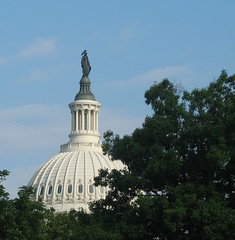
uploaded to flickr.com by OZinOH
Well, duh. I mean, it’s only the reason our neighborhood exists in its present form and why thousands if not millions of tourists a year come to DC. Let’s face it though; unless you work in politics (and there are many of us who do not) or specialize in local interest walking tours (there are a few of us who do) you may spend days or longer without giving the U.S. Capitol a second glance or thought. It’s easy to walk to a Metrorail station and disappear below ground without seeing the giant white dome, or drive away from the building toward Maryland or Virginia without noticing it. Truly something taken for granted, the U.S. Capitol is something our neighborhood can claim that no one else in the nation can, let alone other parts of DC.
Let me focus on the dome of the U.S. Capitol specifically. It wasn’t until very recently that I’ve come to appreciate the way the dome not only commands its views from throughout the city, but also serves as a lighthouse of sorts. When Pierre L’Enfant laid out his plan for DC some 6 million years ago, he hoped to create grand framed views throughout the city using several diagonal streets overlaid on a rectilinear grid. Over the years we’ve screwed up this idea just a tad, but several views are preserved including that looking west on Pennsylvania Avenue and looking west on Maryland Avenue. Here the dome is framed by neighboring buildings and rows of trees, commanding an impressive end to a forced perspective (yes and some ugly garbage trucks and other things that weren’t around with L’Enfant was; just go with it).
The dome as we know it is actually the second dome to be built on the Capitol. The original, made of wood covered with copper, was eventually deemed too small for the growing Capitol complex, as well as a fire hazard. In 1854 an architect from Philadelphia, Thomas U. Walter, designed a new dome made of cast iron and included levels of columns, pilasters, and windows. The construction of the new dome was approved by Congress in 1855 and $100,000 set aside for construction. Like all good large-scale construction projects, the dome went way over budget. Ongoing disputes over design and payment between the owner and the architect made construction all the more lively and interesting (nice to know some things don’t change). The exterior of the dome was completed in 1863 and the interior in 1866. Total cost ran just over $1 million.
For anyone who has lived in DC long enough to master the quadrants and grid, the Capitol dome also serves as a lighthouse. A Hill-resident finding him- or herself in unfamiliar territory (say, Southwest or maybe Chinatown) need only locate the Capitol dome and a nearby street sign to figure out how to navigate home. The dome is visible from several parts of the city as well as Northern Virginia. It greets you as you land at National Airport, as your cross the DC line on I-395 and as your cross Michigan Avenue on North Capitol Street. The view of the dome was deemed important enough that a slice of the new Nationals Ballpark was removed to preserve the sightline.
People love the design and hate the design. People get goose-bumps from patriotism when they think about what it stands for, and they get angry and hairs stand on end when they think about what it stands for. Whether you are Democratic of Republican, conservative or liberal, Tea Party or a regular at Starbucks, you probably can find some quality of the Capitol Dome to call endearing. After all, we all live in its shadow.
What happened to the old dome? Copper isn’t cheap, was it refurbished into something else.
It’s also quite breathtaking to drive/walk/run/cycle past the new plaza on First Street at East Capitol across from the Supreme Court!
I’m a relatively new resident on the Hill (5 months!) and I have yet to get over the fact that I live within looking- (and walking-) distance of the Capitol! Thanks for letting me know I’m not the only one who thinks its cool!
I didn’t know about the new dome either. What happened to the old one?
Sounds like the fate of the old dome is a good question for our resident historian, Robert.
Until he can find out the real answer, I will conjecture that all the pennies in circulation were once part of the dome. Well, the pennies and all good copper pans currently sold on QVC by Wolfgang Puck.
I remember when they took the statue of Freedom down for restoration. Before that she just disappeared up there after she looked bigger, more visible.
What was interesting was to actually see her face and all of the details.
http://www.aoc.gov/cc/art/Statue-of-Freedom-Page-Set.cfm
You can see the mold they used to make the cast for the Statue of Freedom in the basement of the Senate Russell Office Building. It’s pretty cool to see up close.
It especially looks amazing from Pennsylvania Ave. SE right at dusk!