
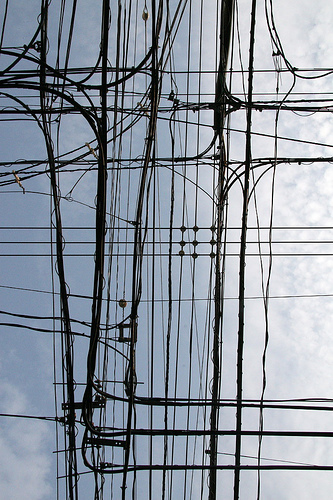
image uploaded by Jim Bogar on Flickr
Ever since D.C. announced its plans to bring streetcars back to the city, the question of powering them with overhead wires has been a hot topic. A law dating back to the 1800’s prohibits overhead wires in the “old city,” begging the question of how DDOT plans to power the streetcars. Once it became clear that the ban could be overturned for the new project, discussions turned to whether or not overhead wires are the best choice for the city.
On November 17th, The Board of Directors of the Capitol Hill Restoration Society unanimously passed a resolution supporting streetcars without overhead wires as the city moves forward with its Streetcar Project, which will include two lines through Capitol Hill. The board believes that while a streetcar system with overhead wires was successfully operated in the District into the 20th century, returning to the overhead wire system now would mean re-introducing an element that has been purposely avoided in the city for more than 100 years. In an effort to preserve the city’s viewsheds, CHRS is asking that the city “conduct a study of streetcar powering systems that are not dependent on overhead wires, including systems in the US, such as the system being installed in Charlotte, NC, and in Europe and other parts of the world.” The full resolution can be read on CHRS’s web site.
The following article was published in CHRS’ latest newsletter:
Streetcars Without Overhead Wires
The Board of Directors of the Capitol Hill Restoration Society unanimously passed a Resolution on November 17th supporting streetcars without overhead wires. CHRS recognized that not only can a properly designed streetcar system integrated with the City’s bus and Metro systems improve public transportation, but streetcar lines can be built for much lower costs than expanding the Metro rail system. Streetcars can provide greater operating efficiency than expanding the bus system because a steel wheel on a steel rail has significantly less rolling resistance than a rubber tire on pavement.
The issue is how to power our streetcar system. Streetcar systems that have been installed in this country in recent years have used overhead wires. Europe and other parts of the world are installing newer, non-overhead wire streetcar systems. The use of established, US-based technology is appealing to the City planners. But overhead wires would introduce an element that has been intentionally avoided and prohibited for over a century. The National Capitol Planning Commission (NCPC) has correctly described Washington as having one of the most significant wire-free networks in the world. This distinct, wireless character of our City has been protected in planning doctrine since the late 1800’s. That has allowed Washington’s downtown streets to be clear of projecting infrastructure and wires that would interfere with our viewsheds. Even traffic lights and street signs have been installed on posts at the curb rather than on cantilevered arms or cables across traffic lanes as in other cities.
Lisa MacSpadden, spokesperson for NCPC, in a letter in the Voice of the Hill (11/20/09, p. 8), pointed out that the City “successfully operated streetcars from the late 1800s to the mid-20th century without using overhead wires” in the L`Enfant and Georgetown areas, and commended the City’s “commitment to study alternative propulsion technologies.” The importance of viewsheds and the need to protect them is clear, but there is now a debate about what part of the city’s viewsheds are to be protected. Is it the original L’Enfant City and Georgetown? Or, as some now claim, merely the “monumental viewsheds” that can be accommodated with a segmented, overhead wire system, that uses batteries to cross avenues and streets that have a view of the monuments, but subjects the rest of the City to the visual pollution of overhead wires? The CHRS Resolution unequivocally states:
“Washington is a planned city with vital vistas and views that make it unique in the world, and those views are located throughout Washington, including areas outside the L’Enfant Plan that deserve protection from unsightly overhead wires used to power streetcars …”
Greater Greater Washington recently published a series of posts on the overhead wires issue, looking at alternatives that other cities have found (many of which have come with problems of their own), how overhead wire technology has advanced in recent years, the hybrid solution they believe D.C. will adopt, and photos of overhead wire systems that truly blend into a streetscape. They make many excellent points, as does CHRS, and this debate could continue on indefinitely.
But now that construction is well underway and the streetcars have left the Czech Republic for the Nation’s capital, time is running out on the debate. I honestly don’t know where I stand on this one. While newer streetcar wires are much thinner and less obtrusive than what they used to be, I’m not sure they will ever look nice or normal in our neighborhood. And assurances that the wires will blend into tree canopies are a bit questionable on streets like H Street, NE, which have very few trees. At the same time, underground power-systems and newer technologies breakdown more often, as noted in the Greater Greater Washington posts. I am also curious to know how the streetcar tracks will hold up through snow and ice.
DDOT says on its website that it “is committed to operating vehicles without overhead wires in certain areas of the city where the overhead wires might impact monumental views. The Department expects to use a combination of overhead wire and wireless technologies throughout the system.” However, H Street, NE does not count as a street with a “monumental view” and will therefore be a stretch that has wires. By that logic, the planned route on 8th Street will also have wires, except at intersections where the streetcars will receive power from underground sources. I can’t help but wonder if such a complex hybrid system will break down more frequently.
Where you do you stand?
Even Bordeaux France which is the poster child for APS in-ground powering uses wires for 2/3 of the track length in their streetcar system. It is also on record that Bordeaux’s in-ground powered track segments cost 300% of the rest of the system.
When mentioning the use of in-ground streetcar powering systems elsewhere the CHRS is always extremely vague. If you really dig down into the details of other worldwide implementations you’ll find that every substantial system is either all overhead wires or a hybrid of wires and alternative power. DDOT is already on the right path with their commitment to use battery power along monumental viewsheds and in intersections where lines cross so their is no rat nesting effect.
We need the additional non-car-based mobility that the streetcar system will provide. DDOT is really thinking ahead with the system (or thinking back as the case may be …)
The time is now. Let’s work with DDOT and the community to minimize the impact of overhead wires and get the system built. DC will be better off with the system in place.
it’s interesting that you link to GGW’s stories about modern wires, and mention that they show examples of how unobtrusive they can be, yet the photo that you use to lead off this article shows some VERY dense wires that in no way represent what overhead wires would look like if implemented on 8th or H streeets on the hill.
i think you should really use a better photograph to illustrate your story, because the one you have now seems like subtle fear-mongering.
I don’t think you could make H Street much less attractive. Let them have wires. There are no trees to conflict with and I’m guessing at this stage of construction it’s too late to put in an underground system, anyways.
However, I do think that wires running up 8th Street are inappropriate. They would require massive tree pruning and probably removal. No thanks. I really think 8th Street is far too residential for a streetcar anyways. Whatever happened to the plan to run it up 2nd?
As a resident who lives near H Street, I wonder how one could say that any street is better or any worse than the other. Sure H Street isn’t the most beautiful street in the District [right now], but I do recall a time when 8th Street wasn’t so pretty either. I’m pro street car, and I haven’t chosen a side in terms of powering them. I say make the system cost effective (so rates don’t jump up every year) and reliable. And be thoughtful about the city and its residents at the same time. The may be new concepts–cost-effective, reliable thoughtful–but we can do it!
The CHRS is being idiotic and short sighted. If you are for “restoring” the Hill then street cars should be a part of this. Streetcars in the past in DC had overhead wires and in other cities in Europe the wires do nothing to detract from the surroundings. This shortsighted nimbyism that is not inline with any effort to “restore” the Hill.
“As a resident who lives near H Street, I wonder how one could say that any street is better or any worse than the other. Sure H Street isn’t the most beautiful street in the District [right now], but I do recall a time when 8th Street wasn’t so pretty either.”
I live near H Street as well. It’s an easy distinction to make.
H Street = No trees, mostly commercial including large retailers, strip malls, major transit way into and out of the city w/ exclusively stoplights
8th Street = Tree-lined, historic rowhouses (residential) with a few small, mostly local businesses, smaller street with many stop signs and only traffic signals at major intersections
There’s no comparison. IMO, a much closer comparison would be any of the “state streets” running through the hill and H-street.
I agree with most of the previous posters, with a special hat tip IMGoph. That was the first thing I noticed.
I grew up in Portland, Oregon, where we have street cars, overhead wires, monumental views (ever seen Mt. Hood), and lotsa trees. I can tell you that the wires are NOT an issue. This hysteria here about the wires, especially to the point where it hampers actually getting the streetcars running, is mystifying.
I think that CHRS, which does very little in terms of advocacy on the future of H Street, is pretty out-of-line to be weighing in on the side of *slowing* positive developments on that street. 90% of the people on that board and those screaming about protecting the views, which are all up on H street don’t come up there anyway.
Essentially, people have to be a little flexible in the pursuit of the greater good. Mass hysteria about overhead wires and misleading statements about the feasibility/cost/preferability of underground systems is just more of the same tired baloney from people who forget that it takes adjusting to some change for big change to happen.
Don’t get me wrong, I’m all for protecting the unique features of the Hill, but when it comes at the price not doing things that move the Hill and particularly H Street forward, count me out.
I wonder how many CHRS members actually catch the bus or bike along H street, or even leave town for that matter. San Francisco, Portland, Or and Seattle have overhead wires for their streetcars. It looks fine, and it works.
Those of us that do use the B2 need more public transportation options, and at a reasonable price. I just heard that the free shuttle will end on Sunday. Where was CHRS to advocate for this wireless option?
Wasn’t the original purpose of the overhead wire ban to make sure views of the Capitol,etc, weren’t blocked? Not a problem on H St.
Mostly, my opinion is “faster, please.” I really like the streetcars plan.
I think the “all wireless” option will never get out of the station. Constructive commentary on where to go wireless and where to accept wires is the next logical point of discussion on propulsion.
CHRS has drawn its line on the map: “the area south of Florida Avenue/Benning Road, west of the Anacostia River,” they write in their resolution, is the L’Enfant Plan area that is protected by the National Capital Planning Commission and on the National Register of Historic Places, AND there are other “areas outside the L’Enfant Plan that deserve protection from unsightly overhead wires used to power streetcars.”
That seems a little too broad for me. It depends on what the engineers say will work reliably and at a reasonable cost, but I’d be satisfied with protecting vistas along state-named streets and intersections with those streets, then take on a case-by-case basis the arguments for other stretches that should go wireless if possible.
Regarding H Street NE, the first leg of the streetcar system on Capitol Hill:
A couple of fictional characters from Edward P. Jones’s short story collection, “All Aunt Hagar’s Children,” talk about what makes H Street NE special.
In “Adam Robinson Acquires Grandparents and a Little Sister,”
“Where were all the oaks and maples and birches, even the odd pear, apple or peach tree, that had been there in the time when he did not yet know himself and the city seemed always as green as his granparents’ idea of Heaven?… The cab approached H Street, N.E. He could see box after box meant for trees existed now only to support litter. Between the parked cars, Noah could see that the city government people had thrown up the occasional young tree, like the one in front of his apartment building….They would not live out the year. ‘Root, little pig, or die,’ his father and grandfather liked to say….Noah forgave that street for being virtually treeless, for that had always been its way.”
And in “Root Worker,”
“All that week of being ten her father had promised her a Saturday of shopping and a movie at the Atlas theater and a half smoke from Mile Long as they went up and down the busy commercial H Street….She might have been able to look down toward H and see all the excitement of a Saturday on H Street. The happy children. The Atlas announcing in big letters on its marquee what extraordinary movie awaited a child…and candy without end might rot a girl’s teeth on any other day of the week, but not on a special Saturday.”
I hope that helps people as they think about the H Street streetcar and overhead wires.
For all Hill folks, I hope you read Edward P. Jones’s two collections of short stories! Great literature, set right outside your front door!
Hill Resident:
All I’m saying is that things can change. Don’t underestimate what could be. It may take a while and it may never live up to its potential, but it could be a great street one day.
Paul, in-ground powering systems such as Bordeaux’s only make sense when there is a major existing fleet of overhead powered streetcars that can, at moderate cost, be modified to access external power in a less obtrusive way…from below or at some passenger stops.
But where no such fleet exists (the typical USA situation) the high capital cost, interference with buried utility plant, ongoing maintenance, and general antiquity of the whole external power concept favor on-board power over any external supply option.
This will probably wind up as hybridization of batteries charged off the grid at night and augmented during service hours by small, clean-tuned constant-speed diesels; by compressed natural gas gensets; or via hydrogen…either efficient fuel cells or less expensive but less efficient H2 internal combustion engines.
Risk of interference with buried utility infrastructure is a strong negative for any external power alternative.
The potential for subsequent retrofit with better batteries and cleaner future generations of prime movers favors onboard power alternatives.
I have been a resident of Woodley Park for over 10 years and a Washingtonian for even longer. Few proposals in the District have made me as excited as this one has. For the first time, I see a mindset geared towards progress and expansion. Washington, DC is a wonderful city with vast potential to be a world class metropolitan area. The hysteria that has been created from overhead wires is simply unfounded in my opinion. Having lived in Germany for most of my life, overhead wires seem a natural occurrence in a city. Frankly, I would find an overhead wire fare less unattractive than a vacant building. There are a series of legal and, more importantly, engineering debates that need to take place in regards to power supplies for the street cars; however, stalling the entire process (which will take a while to complete without these potholes) due to an overhead power source is the same attitude that has hindered DC for years. With a population on the rise and an eye towards the future it is time that groups such as CHRS are marginalized and relegated to their appropriate roles. While they should always have a voice for their organizations it should not be able to derail projects. Far too often in this city does a small, unrepresentative group masquerade as the opinions of the majority. I have great hope for this coming decade in Washington and hope that others will join in voicing an opinion for real, demonstrated progress.